Tuesday, June 16, 2015

AMA Post-Uganda: Part Two

Part Two of the questions sent to me on Facebook. 
Still curious? 
Give me a topic and I would be happy to write about it!

How was worship different?

The town that we lived in was very heavily influenced by westerners, which was both good and bad. We began by attending a “house church” led by other American missionaries, and it was such a gift to grow in our faith with others who understood our lives. We made some great friends who ended up supporting us like family over the course of the year.

In December, we really felt God calling us to move to a Ugandan-led church, specifically the church that all of our closest Ugandan employees and co-workers attended. It seemed more natural to be worshipping with those who we were also doing life with throughout the week. So, for the rest of our time in Uganda, we attended Calvary Chapel Jinja. Although the directors are American, the pastor and church leadership is Ugandan.

I think I expected a loud, movement filled, energetic worship time, but honestly, the biggest differences were in the sincerity of prayer requests and praises shared. We did sing and dance to worship songs in both English and Luganda and the sermon was translated verse by verse, but when a sick child was better, or a family was able to afford school fees, or there was enough food to last until payday, those families dropped everything to come and thank God publicly for the way He provided.

Worship was very humble and the sermon messages were based on verse by verse reading of scripture rather than being more story-like as we tend to be in the U.S. Because of the fact that the prosperity gospel is rampant there and the fact that most Ugandans don’t read the Bible for themselves, but have to trust what they hear on the radio or in church, most reputable churches stick to the scriptures very closely.

At certain times, where we might add an “Amen!”, there was a special, high-pitched “Aye. yay, yay” type chant that would be shouted. It was sort of a combination between the noise my mom used to make to call us home for dinner and the noise my kids make when they are bombarding each other with water balloons. It is a wonderful, celebratory sound that I miss.


Coming back, do your kids feel like they missed anything, or do they feel like the rest of the people missed out on what your family was doing?

Watching the kids transition home has been interesting. Returning physically and practically hasn’t been hard, but emotionally and reflectively it has been challenging. Even our older children are just beginning to enter the stage of life where they can grasp abstract ideas such as justice and the great “Who am I and what on earth am I here for” questions. Since thinking about and communicating these issues is tricky, it manifests itself in heightened emotions, being overwhelmed by simple tasks and a good deal of denial and avoidance.

For the most part, they haven’t had a strong desire to talk about Uganda. Sometimes it’s just too hard to even think about the people we love there, so it’s easier to pretend that life as we know it was just frozen in time. To not know if we will ever have the chance to see these people again is hard, so remembering is painful. I think that is something that they will unpack gradually as life goes on and memories surface.

We have had some great Skype sessions with David, our guard who became like family, and the kids have really enjoyed those!


Carter, getting the sigiri ready for us to cook lunch. Things like this are so hard to describe to peers and makes talking about Uganda difficult.
With their friends, it’s hard to share simple stories or memories because they require so much explanation.
The older ones have mentioned that they think their friends have missed out by not having the opportunity to see Africa first-hand. There are so many things that simply cannot be explained or contained in a photo.

They definitely feel like they have had an amazing opportunity and feel like they go the best of both worlds by being able to do life in two very different places. While in Uganda, every day was such an adventure that the kids didn’t long for anything, but now, being home, they appreciate being able to play sports, hang with friends and ride bikes all around the neighborhood.


Do you dream about being there and wake up to realize it was just a dream?

For months I would dream about familiar places in America, and then wake up in Uganda sort of sad. My dreams were always simple, like picking the kids up from school or driving past familiar places. For some reason, my recurring dream was simply driving eastbound on Raab Rd in Normal past Steak-n-Shake. I never seemed to have a destination, but that is the part of my dream I remembered and that struck an emotional chord with me. I so longed for simple things when we were away. I longed to drive familiar roads, to sit in “my spot” in church, or to take a deep breath that didn’t smell like burning garbage.

Since being home, I haven’t had any dreams of Uganda that I can remember. I actually can’t think of any dreams that I have remembered since being home. Much of that probably has to do with stress levels and sleep patterns being all mixed up.

I do hope that at some point I can visit Uganda in my dreams. What a gift it would be to walk the familiar roads and greet those friends that I miss so much, even if only in a dream.


What was the first American cuisine you had? Or what did you miss most about American food?

We did sit at dinner many nights and discuss the question, “If you could have one thing to eat right now, what would it be?” It was pure torture! We missed ice-cold milk, sour cream and real cheese. There was one dairy in town where they made these things specifically for the Westerners, but it was too expensive to have regularly, so for cooking we got boxed milk that didn’t need refrigeration and we ate the “cheese” that never actually melted.
Although the food was not bad by any means, it was simply more complicated. It was so difficult and time-consuming to prepare meals, and due to all of the creepy, crawly bugs that lived with us, even storing food and having it in the house was often a problem.

We were greeted our first night in America with a dinner from Biaggi’s Restaurant which had been dropped off by a friend, so it was a delicious start! Many of the things that we missed so much or that were part of our discussion over Ugandan dinners we still haven’t had yet. I think we simply missed them because we couldn’t access them at the time.

Although we didn't know we missed them, we all have been eating our weight in bagels and cream cheese since our return. I am also enjoying Drumsticks ice cream treats and Charleston Chews. 


Do you feel dissatisfied & disappointed with American life since it is customary to take so many things for granted?

We are not dissatisfied with American life. If anything, I think we are much more grateful. I appreciate our home and air conditioning and the ease of traveling on good roads to see family. I am thankful for the opportunities that we have and the freedom to create the lives that we want for ourselves without oppression. Even though our justice system has its issues, the corruption that we see in this country is NOTHING compared to Uganda. I see my privilege more clearly now whereas I used to focus on what I lacked.

Something that I am struggling with currently, and I don’t know if it is an American thing or simply a human thing, is taking sides on any issue.

As many of you know, I am and have always been a very opinionated person. Give me a topic, and I used to be able to tell you exactly where I stood. I have always been very sure of myself and I love researching topics and learning to gain knowledge on many topics.

My foundation was shaken in Uganda though.
Things that I was absolutely sure were truths, turned out not to be.
Things that I had read as an American turned out to be absolute lies.
Ministries and people who I had followed on social media and blogs, in real-life were not all they had claimed to be. One good picture of a sad, little African child could raise thousands of dollars even if they never did anything to help that child or anyone like him.

The deception is great, and to live that was hard.

I am trying to differentiate what I can really know to be true and what makes me feel better to believe is true. We are so quick to jump on bandwagons and share articles and have opinions on any given topic on any given day, and honestly, we have no idea of the truth unless we are directly involved.

I need to re-learn how to trust information and people again. I am much more skeptical of everything that I read. I am doubtful of anyone who claims to know anything for sure or who has a passionate opinion. I am much more drawn to someone who would say that they don’t know, but are seeking truth.


Please share a few cultural differences that you admire about the people you met.

I LOVED the relational emphasis on life in Uganda. You would never walk up to someone and just start talking or wave at someone as you passed. When you see someone, you stop what you are doing, engage in a thorough and genuine greeting and only then can you continue. You might even continue to hold hands the whole time while you talk. I miss that pace of life and that nature of relationships. No one seemed to beat around the bush or pretend to be something that they aren't. That was refreshing and made doing life imperfectly much easier. 

People always seem to come back from developing nations and say that the people had very little, but were just so happy. I find this sort of cliche, and slightly inaccurate. If you observed from the outside or only met someone one time, I see how it could appear this way. Most Ugandans would not burden you with their struggles, just as we wouldn't lead with our failures when meeting someone new, but there is deep pain, oppression, and a lack of hope in the lives of many who live in poverty. 

Although the people are incredible at finding joy, creating joy, I wouldn't say that they are overwhelmingly happy. Many have the same dreams and goals as we do,  but due to circumstances beyond their control, a society that is set up to "keep people in their places", and an overwhelming amount of ineffective ministries, they simply cannot live the lives that they want without outside help. 

I love that despite all of this, when given an opportunity, they will do just about anything to succeed. They will humble themselves, work harder than you or I could ever imagine, and sacrifice everything that they have. Many Ugandans truly want more, want better for themselves, but the systems are not there to enable them to improve their lives without help. 

The kids seem to have adjusted well. Is that assumption true and what (if anything) was the hardest thing for each of them to adjust to- being back home?

The kids truly have adjusted well. They were incredible travelers and were so easy going with all of the changes when we first got to Uganda, and they are being troopers now that we are back as well. They truly are resilient. So much of their identity is based on us as a family, so as long as we are all together and well, then each of them seem to be confident and secure. Dave and I just began couples counseling last week to keep our foundation secure. The greatest gift we can give our kids is a solid marriage, and we are in a season right now where that takes a little more work than usual. 

As I have written about previously, the emotions are all bubbling very near the surface, so we have had some breakdowns every now and again, but that has been the worst of it.

The hardest part for them, I think, is having these big emotions, but not being able to define the cause. They are used to being mad about an event and crying, but to feel so overwhelmed with sadness and not be able to pinpoint the cause is new to them. We have had to explain quite a bit that sometimes our bodies just need to cry, and that we should let them.


Did you ever feel unsafe or in danger? I have no idea what the political culture is over there.

We lived just a few blocks from the home where the Ugandan President stays when he is in Jinja, so we were in a great “neighborhood”. The country is pretty stable politically also, so overall, it was peaceful, but at the same time, if there was ever a crowd, we would not want to be caught anywhere near it and pick-pocketing was a constant threat.

I really missed having the ability to call 911. My mind was really good at racing to worst-case scenarios. There was no 24-hour emergency room, no ambulances, no fire trucks, and no way to call police…even if you walked to the police station, the police only work on bribes supposedly. There was no sense of security for me in that respect, but fortunately, we never had a need for any of that any ways.

Although we were in a peaceful city, things get out of control very quickly, and you can’t just call the police to diffuse a situation. If someone is accused of stealing from the market, a group of people would just catch the person and beat them, and everyone would be satisfied that justice was served. Everyone is guilty just by accusation, and there is no chance to prove innocence. Beating someone to death if they stole or broke onto someone else’s property is acceptable and almost expected.

One time we were driving down Main Street and we don’t know what started it, but a pick-up truck with about 10 guys in it came barreling down the road chasing another vehicle with no regard for the crowded streets or the hundreds of people. They were on a mission to “serve justice” at any cost. While all of the Ugandans ran to follow and see the outcome, we quickly turned around and drove the other direction as fast as we could.  

Politically and culturally, due to the color of our skin, we were respected and admired, for the most part in a very positive way. It is a great social boost for a Ugandan to have an American friend, or to be seen with Americans, so the kids especially felt like rock stars. In that way, we felt safe. Ugandans were happy to have us there.


What, if any item/luxury item would you consider doing without now that you are back in the states if you had to pick one thing?

This is a hard question for a few reasons. 1) We went for so long (years leading up to Uganda and then the year itself) without many luxuries, I feel like we deserve them now more than ever. 2) We live a fairly simple life, so what are luxuries to us are most likely the norm to others.

One luxury that we now enjoy: air conditioning. As soon as it got hot, it wasn’t even a question, we just turned it right on.

Although we missed our dishwasher and garbage disposal, we could do without those. In fact, once we moved back into our own house, I had gotten completely done washing our first set of dinner dishes by hand when I realized that I could have stuck them all in the dishwasher!

I enjoy air conditioning in our van. I appreciate the luxury of paved roads.

I lived without a dryer, but I didn’t enjoy it. I like warm, soft, bright, clean clothes.

We discovered long ago that we could go without television and we haven’t had cable in a really long time, but we did just sign up for Netflix and ordered our own wi-fi instead of sharing our neighbors like we had been for over a year before we left. Many family members do enjoy television and movies though, so we do own a few and are enjoying movies and shows.

Once we start working again and can save up some money, we will buy a nice sectional. The furniture was so, so uncomfortable in Uganda, and even hurt my back quite a bit. A good couch is so much more than a luxury though, it is also a family snuggling spot, a place of fellowship for guests and a welcoming part of our home.

So, I didn’t really answer the question well, but I do know that guilt does no good for anyone. If you are feeling convicted, like you would be happier or more engaged in life by eliminating certain luxuries from your life, then I believe you should honor that and try living without it. If life is more stressful and you are more engaged by using those luxury items, then I say, “Go for it!” There is not one right way for all of us to live. We are all on different paths with very different lessons to learn.


How did you learn the language? I know younger kids often pick up on the language faster that adults learning a new language.

The official language of Uganda is English, so that is what is spoken in schools and is what kids are taught to read. Many Ugandans don’t have the ability to attend school consistently, if at all, though. Many of the people we worked with in the villages did not speak English, but spoke Luganda, so our Ugandan co-workers were interpreters for us. There are many, many languages native to Uganda, and different villages spoke different languages, so although we learned some, it really would only be beneficial if we went back to that exact area of Uganda.

While we did pick up some greetings and frequently used words, that was the extent of it. The kids did pick it up much faster than Dave and I. I even tried studying flash cards and practicing phrases with anyone who listen to me, but nothing seemed to stick in my brain like it used to. 


Wednesday, May 27, 2015

AMA Post-Uganda: Part One

What are some things you notice about the "necessities" of American living that really aren't necessities at all? What can we do without?

I have to admit, I left the US very bitter about Americans and our values, priorities, and “problems”. God had been preparing our family for a few years to live with less and to focus our energies inward as a family and outward in mission. We were focused and living very differently from most of our friends, and frankly, I thought we were doing it right.

We let our fridge remain broken because it still functioned, we didn’t replace our carpet, we stopped paying for haircuts, we embraced the imperfections, the weeds and the scratches. What martyrs we thought we were.

I was talking to an American friend who I met in Uganda about this, and she was quick to remind me of grace. Grace is a necessity no matter where you live or what you do. Just because God had revealed something to me, a way that He was calling me and my family to live for a season, He didn’t call me to impose that on the rest of the world. We are each called according to HIS purpose for us individually. There is simply no right way to live out God’s call except with absolute grace and humility.


It’s funny, too. After living in Uganda and missing some of the modern conveniences, I am desperate to have nice, clean, things that work! We did replace our carpet as soon as we moved back into our home, and as much as I thought I would continue hanging my clothes out to dry in America, I am over it. I love my dryer and my extra-large capacity washing machine. And, I even think God is okay with that.

Inevitably, I would hang out clothes, and it would start raining. Our clothes also were faded, eaten by bugs, and stiff as a board. Do we need dryers? No. Are they awesome? Yes.

I need grace. We all need to both give and receive grace freely. 

So, could we live without a dryer, an ice-maker in our fridge, air-conditioning, radios in our cars, dishwashers and a million other things, yes, we could, but unless God is convicting you as an individual to eliminate those things, then there should be no guilt.

I will say that our family is at a stalemate over the TV issue. We gave up cable several years ago, had Netflix for a short time, check out videos from the library for free, but we are once again trying to decide what role TV will have in our lives at this point. I feel that TV has the potential to draw us away from each other as a family and away from time we could be spending with God. My family likes to have downtime and relax with TV. Honestly, I do, too, I just wish it was easier to strike a healthy balance.

I now believe that it is healthier to ask: What gets in between God and myself? What distracts you from living in obedience? What hinders your relationship with Him? 

Those are the things that you can do without. I promise, they will be completely different than the things your neighbor can do without. 


Would you go again? And would you ever consider staying there permanently, if that were possible?

We would all go again in a heartbeat. Our friends there became like family and it is so, so hard to not know when we will see them again. Many of those closest to us don’t have facebook or internet access either, so there is absolutely no communication. We loved our year for a million reasons and in a million ways. If we could visit once a year for the rest of our lives, we would be so happy. Unfortunately, with a family of 8, that would be near impossible financially.


I would not choose to live overseas permanently, and I think the rest of the family would agree with that, though some would probably consider it if the right opportunity came up. It was just too much of a burden on my heart. I struggled with situational depression while I was there, and it just wore me out mentally and emotionally. There are no easy fixes and no obvious solutions to many of the problems facing Ugandans. Our call in being there was very much to walk beside others IN their suffering. That is hard.

There are several teaching opportunities that Dave and I could have had in Uganda to stay. There are also a few organizations that would welcome us back to serve with them. We don’t have any plans to travel again though. We feel that it is a time to dig our roots deep until God tells us otherwise.


What were your favorite new foods you ate?

I need to preface this by saying that we are NOT adventurous eaters at all. I had at least one friend who was sure that I was going to starve to death when I left the U.S. We did stretch ourselves though, and tried many things. I don't know if we would categorize any of them as favorites, but we could eat them all when the occasion arose. 

Dave was offered a cup of warm milk straight from a scrawny, sickly cow, but he did get out of drinking that somehow.

The kids loved sugarcane, which isn't shocking. It is like a giant pixie-stick in its most natural form. 


There was a little four-leaf clover-looking plant that grew everywhere, and someone told the kids that they were called “yum-yums”, so the kids ate them all the time from our yard. I tried one and it just tasted like grass, so I am not sure why the kids loved them, but they did.

Chapati was the Ugandan staple that we ate the most of. It’s sort of like a greasy tortilla, but it’s the only meal you can get that doesn’t take over an hour to prepare, so in pinch, chapatis are an easy dinner. The street vendors also will wrap eggs and vegetables in chapati and serve it as a rolex. Typically we did that on Friday nights after soccer club.

A Ugandan staple is matoke and g-nut sauce, but we were not fans of it. Matoke is similar to sweet potato, but more stringy and bland, and it would be covered in a brown sauce that tasted like liquefied peanuts. To me it was a strange combination, but we could all manage to eat it when we needed to.

Passion fruit, mangos, and papayas grew everywhere, so we did help ourselves to so much fruit right off of the trees. Our neighbor cut down a papaya tree one day, and the top half fell into our compound. They said we could have all the fruit, so that night I took 3 or 4 giant sacks to church to share. You should have heard the hooting and cheering that accompanied that abundant blessing!


Why is it so hard to transition back?

I have heard this question answered with an analogy, and it really is a good question.

Living in America, we are all “yellows”. We know how to do life, what the norms are, and how to speak and act like “yellows”.

We then traveled to Uganda, a land of “blues”. We loved the “blues” and learned how to live with them. We learned their language and their customs. Although we never turned fully “blue”, we were changed.

Now, we return to the land of “yellows”, and because of our experiences with the “blues”, we find that we are no longer fully “yellow” anymore.

We are now “green”.

A part of both cultures is alive in us and have become part of who we are. The only problem is, that we are different, we are not fully “yellow”, nor are we fully “blue”. We will forever be “green”, and there is a joy and a sadness that accompanies that. We are richer because of it, but there is a tug, a part of us that longs to be both wholly “yellow” and wholly “blue”, and an acknowledgment that we can never be fully one or the other.

*********************

Traveling to a developing nation is different than traveling anywhere else in the world. This is one reason that people are so dramatic after returning even from just a week or two in Haiti, the DR, or other African countries. We are extremely isolated in the US. We can stay on one side of town and avoid seeing the homeless. We can avoid certain schools and never see a hungry child. We can stay out of the hospital and avoid seeing the sick and dying.

In Uganda, there was no avoid any of this. Every day, every waking hour, we were surrounded by things that just shouldn’t be. Each day my prayer was simply, “God, come quick.” So much is beyond “fixing” and requires us only to trust that there is a plan and a purpose far beyond our understanding. That can be a gift, but it is overwhelming.
Musisi suffers from chronic jiggers. No matter how  many times we teach his mom what she can do to prevent infection, she doesn't do it. Our heart breaks for him when it gets so bad that can't even walk.


This was Morris when we first met him. We connected him with the proper help. Below, his improvement is visible. Will his mother continue to follow through, or will she abandon him again?


Coming back home leaves us with the burden of knowing that people we love are still hurting. Once we have seen, we cannot pretend that we haven’t. Once we have held that starving baby, sitting alone outside his hut with his mother nowhere to be found, we can’t forget. I think about that baby every day and I wonder if he is there alone again. I know he may not live much longer if his mother doesn’t make different choices, but I will never know. That baby, and the fact that I had to set him down, starving and alone haunts me, but I know that there is nothing else I could do, and that there are millions of other babies just like him. 

What We Wished We Had/Hadn't Packed

My cousin Heather asked me, shortly after arriving in Uganda, what we didn’t pack, but wished we had, and what we had packed, but wished we hadn’t. It was too soon to tell at that point, but I thought about that question constantly while doing life there.


We packed so many school supplies that we either didn't need or could have easily purchased in Uganda, things like pens and pencils, crayons, highlighters, lined paper, worksheets and textbooks. When it comes right down to it, all of the basics can be covered just fine without all the bells and whistles, and the kids did great. (Or else that is just what their current teachers are telling us to make us feel better. It's okay. We'll take it!)

We ended up with more bug spray and sunscreen than we needed, but our night guard appreciated the bug spray, and we were able to pass on the sunscreen to several other ministries and missionaries.
I wish we had brought our own printer and ink instead of having to go to a shop to print things and make copies. When I sent our Ugandan friend, David, the price would be about half of the “mzungu price” that they charged us.

As far as food went, it was better to just forget about our American favorites and embrace what we had available, but tacos were a staple dinner and we did have extra packets of taco seasoning sent over in care packages. We ended up with a few ranch dressing packets, too, but those require sour cream, which was not available. Dave had to find a recipe to make sour cream using vinegar, cream, and milk and after letting it sit out for 24 hours, voilà, you have sour cream that you can then mix with ranch packets to make ranch dressing. Needless to say, we didn't do that much.

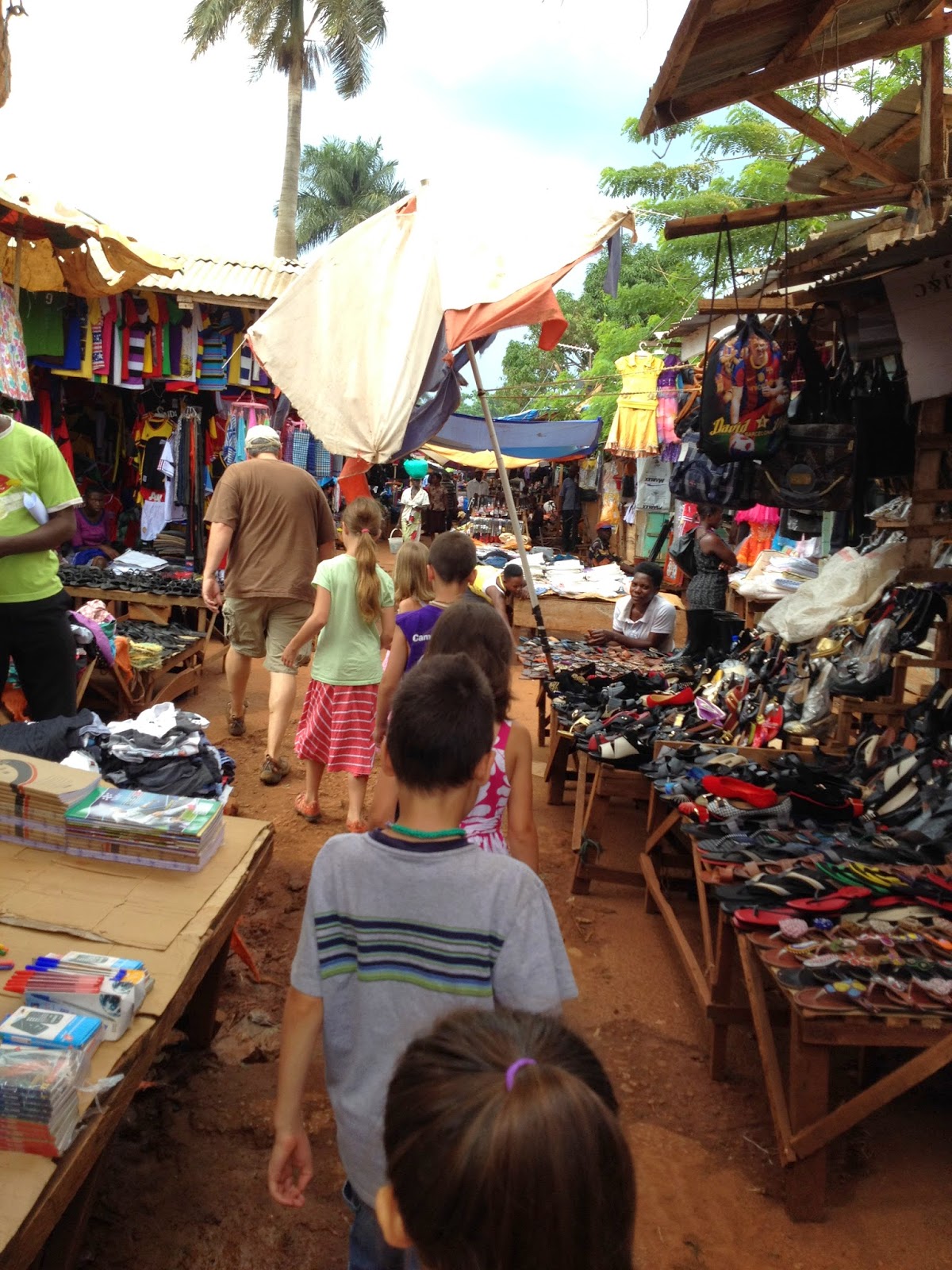
This is Central Market, where we bought all of our staple food items (rice, beans, fruits and vegetables) , tools, clothes, shoes, blankets, etc. There was a booth for just about everything. Most of the items were in used condition. This is where a good deal of the items we send to those less fortunate end up. Most items are from America and Europe. There are no prices on anything, but you can bet that whatever price they first offer is at least double what the actual value should be. 

There were many booths in the market where we could purchase tools, but they were not nearly as sturdy as the tools that we have in America, we wished we had brought a few more of those.

Also, shockingly, I wish we had brought some nicer clothes and my make-up. We were very conservative in the amount and type of clothes that we packed because…Africa. From the very first week though, I was caught off guard at missionary gatherings where all the women were still complimenting each other’s adorable new scarf from target or asking where they purchased their cute shoes. Evidently some missionaries have regular care packages sent over to keep them trendy.
While our style helped eliminate one more area where we would have been set apart from our Ugandan friends, even Ugandans spend a good deal of their salary to look nice on special occasions.

We did manage to scrape together something nice for most of the kids on Christmas...and those we couldn't find something nice for, we just hid in the back for pictures. :-)  What you also can't see here is Carter wearing basketball shorts with his button-down shirt.

Our home did have electricity, but no matter how nice the house is in Uganda, Umeme, the power company, could decide to turn the power off to all of town or certain sections with no explanation. We never invested in one, but some nights, we wished we had a large battery powered light to get us through dark shower times and bedtime stories.


We are so glad that we brought cereal containers with strong seals to keep the bugs out of our rice, flour and sugar. Our matchbox cars and magnetic trains took a good deal of the weight limit in our luggage, but the toys were so different than Ugandan toys, that many kids we had over LOVED them!

Cell phones are a necessity as there is no such thing as landlines in Uganda. You simply purchase a sim card, put it in your phone and buy airtime cards which give you a certain amount of minutes for phone calls. We had no idea which phones would work for us there, so we ended up with several extras donated to us that we were able to give away and provide a much needed lifeline to many of our friends. For someone in the village, a cell phone saves them having to walk many miles to ask a simple question or access a resource located in the center of town.


So, overall, we were happy with what we packed, especially since we had no idea what to expect. Even some of the things, like towels and bed sheets, which we could have purchased in Uganda, we were glad that we brought on our own for the simple fact that you need to negotiate the price for every single item you purchase. It is just exhausting and due to the color of our skin, we would still end up with a price double or triple what a Ugandan would pay. 

Thursday, May 21, 2015

Unsettled Hearts

The day we arrived back in the country, we pulled up to our house to drop off the 16 bins carrying our life for the past year. New houses had been built, old neighbors had moved out, and new neighbors had moved in. So much was exactly the same, but so much was so different. 

In Uganda, we went from having a 6 week countdown going strong, to being told that we needed to leave the country within one week. It was a crazy mix of emotions. We had been gearing up our hearts and minds to come home, and we were excited, for sure, but 6 weeks is a lot different than 1 week. (We are still just as in the dark as all of you about why we were told to leave early. We don't know all that is going on with the ministry that we worked with, but we trust that God was so much in the timing, and though we were surprised by the change, God was not.)

As we drove into the neighborhood, I noticed that some good friends were playing outside, so I said to one of the kids, "Why don't you run down and say hello?" I had no idea how bad that idea was. It was too soon. My precious child went running excitedly, stopped suddenly halfway down the street and then came running back to me hysterically crying. Through sobs he said, "I can't do it. I don't know why. I just don't know who I am supposed to be with them."

"I don't know who I'm supposed to be." Wow. 

Through my own tears I considered giving the "just be yourself" answer, but somehow I knew that this was much deeper and more complex than that. So we went in the house and let the emotions come. 

His poor heart didn't recover from that for at least another week. He asked to not see any friends until he was ready. Maybe I should have seen that coming, but then again, I don't think he had any idea until that moment running down the street either. 

********************************************************
Another simple question, another unexpected response.

"Hey, do you want to switch bedrooms with your sister since she likes your paint color and you don't," I asked.

Instant sobbing. Runny nose, hysterical crying and pacing the room. 

"Mom, it makes no sense, but all I thought about in Uganda was my window. I missed my window and I like where my room is. It's just too much to think about. I can't handle it. The change is too much."

Of course, it didn't make a difference to me. It seemed logical for them to switch instead of repainting 2 rooms, but it didn't really matter. 

The familiarity of something as strange as a window brought up so much emotion.

**********************************************************

Since we came home early, our renters were still living in our house, and we had the blessed opportunity to be invited into the homes of many friends who love us dearly. Those weeks were such a gift, and although we knew it on some level, until last night, I had no idea just how great a buffer those homes were between the world we left and the world we call home. 

Those weeks gave us time to adjust slowly to America. Our church had provided groceries that lasted for the first couple weeks, so we could avoid being overwhelmed by the stores for a while. Our friends let us dig through their kids' clothing when we had nothing to wear because all of our Africa clothes was full of holes, faded by the line drying and stained by the bright red dirt. 


To me, that old clothes was trashed, to the kids, that clothes was precious. We gave away all of the decent clothes while still in Uganda, and it was my intention to throw away all of the clothing that did make it back here with us. The kids didn't let me though.They wouldn't stop wearing the worn out clothes that they had become so accustomed to over the past year. For them, that was one way to hold on, one more piece of the past year that they weren't letting go of just yet.  Last night, 6 weeks after coming home, I had them go through the plethora of hand-me-down clothing that we have been given. I wanted the kids to find what they loved and fill their closets back up. They wouldn't take more than a handful of items. The girls picked 3 shirts and thought they were done. After all, we lived a year with only as many outfits, why would we need more than that here?

So, now, we have been back in our very own house, with all of our old stuff out of storage for 5 days, and they have been the hardest 5 days of my life. The crazy, unpredictable emotions, the lack of patience we all have, and the stress of making decisions all weigh on us.

Every decision seems so important and so big. We don’t remember where we used to have certain furniture or items in the house.  And even if we did, would we still want it there now? It feels like now is the time to start fresh and incorporate newness into our old patterns, but at the same time, we are craving the comfort of old routines. I still keep going over to the pen drawer and expect it to be organized like I've always had it rather than holding the one lone pen as it does now.

While we crave the comfort of old routines, even those are elusive. Who did we used to be? What were our roles here? Did you do the vacuuming or did I? Who was responsible for laundry and grocery shopping? Does this distribution of labor make sense now? I thought you would take care of that. Well, I thought you took care of that. 

We were only gone for a year. In reality, it wasn’t that long. I know that. I feel silly not remembering the simplest parts of our life here. It’s hard to explain, and it makes no sense logically. Maybe this is the part that they say you have to experience to understand, but I will do my best to paint a picture of where we are right now.

Moving to Uganda was like moving to another planet. Our lives were turned completely upside-down. Very few things resembled our lives here, and the stress was constant. We held starving babies, saw death, experienced manipulation, witnessed severe neglect and devastation and were faced with plenty of situations where there was nothing we could do but pray and trust that God would intervene, or that He had purpose in the suffering. So much of our day-to-day life, the things that were “normal” in Uganda, caused our hearts to throb. If only our hearts could have just broken, it would have felt better. The tension, the pressure would have released, instead it was this swollen, hurting emotion that could not be comforted. Each time the phone rang or someone knocked on our gate, we had to be prepared for our plans for that day and sometimes that week to be altered. Living in a developing nation, almost everything is an emergency. Living on high alert for an extended period of time is exhausting and terrifying and required us to be ready for anything at any moment.

I read that many people come home with a sort of mild Post-Traumatic Stress Disorder. I am starting to understand that a little. Even though we are safe and life is okay, our hearts hold onto what we’ve experienced. In those moments between wake and sleep, we revert back to the state of high-alert, or our hearts wander to the friends we love there and the people we know are still suffering. Relaxation is difficult, and if we do fall back into our old patterns of life and live carefree, then where do we put what we have seen and experienced.

It’s easier for me to focus on the kids and on their processing because, in a way, that is one more distraction to allow me to avoid my own processing, but it is becoming unavoidable. Dave and I have been struggling with the most basic communication in the past few days, and it is scary when your marriage, your foundation feels uncertain. We have been snippy with each other, and have lacked grace. (Doesn’t that sound so sweet? “Lacking grace” sounds so much nicer than admitting the rude, mean, controlling, hurtful things we have said and done lately. :-s) We called it what it was last night though, and found a place of peace. Sometimes just naming the thing stops the negative thoughts from growing and eliminates the need to blame each other. We can blame the thing instead and that leaves room for grace. 

Who are we supposed to be? Who is God calling us to be now, with what we have learned, with what he has shown us? We don’t know the answers, but I think these are some of the right questions no matter where we are in life.

When God called us out upon the waters, we walked with confidence. We never once felt outside of the will of God, but we did let Him drag us through some things that we would never have chosen to experience if we were in charge.

A friend recently described God as being “thick”, not an adjective commonly used to describe God, but it spoke to me. God is absolutely the center of our lives. He is in control and uses every single thing to draw us closer to Himself. We want nothing more than to be where He wants us. Sometimes, that is full of joy and hope and wonder and all things good. Other times, that feels more like quicksand or like walking up the down escalator. I have moments that I want to bow out of certain situations. I want to tell God that it’s been great, but I want a life that is easier. I don’t want to be strong or stretched or grown any more, but God is thick. He doesn’t make me stay, He lets me go. He lets me give Him the silent treatment and ignore Him. He’s thick like peanut butter though, and when those moments last for days, and I feel like I've pulled so far away, I turn back, and have to laugh because I haven’t gotten very far. And what a gift that is. What a gift to be loved by a God who can not only handle all of my brokenness and my attempts to run my own life, but who watches me  turn my back and just remains there with open arms no matter what I say or do.

May I extend to others just an ounce of the grace that He has given to me.

Friday, April 3, 2015

An Early Departure

Dear Family and Friends,

We are all okay. We are healthy, and we are safe. It is with a broken heart though, that I share with you that we will be coming back to America next week, much earlier than expected.

Please cover us in prayer as we journey through our last 5 days here, filled with heartbreak and hard good-byes.

Due to powers beyond our control and our need to do what is best for our family, we will be coming home. We had no idea that this was coming, and were taken aback just on Tuesday to find out our plans needed to change almost immediately. It has been a shocking and difficult week.

We spent a crazy two days packing, and now we are on to the hard part, saying quick good-byes to all of those we have come to know and love dearly in our time here. We are fortunate to have developed such incredible friendships and to have been loved so well here, but, of course, it makes leaving that much harder. 

Tonight, at our Good Friday service, Calvary Chapel Jinja, our church home-away-from-home, who have taken us in as family, gathered around us and prayed over us. To think that this is all coming to an and is difficult. There is so much that we are going to miss. So, so many wonderful people who have taught us so much.

The kids were so excited on Tuesday when we told them that we got to go home early, but as the reality has sunken in, that excitement has wavered. We have built a life here in the past 10 months. We loved deep, and we loved well. We gave our whole hearts to the people and the work here.

As we stood in church tonight, singing worship songs, Carter buried his head in my chest and sobbed heaving sobs. I held him and we simply cried together. I so, so much want to protect the hearts of my children. I want to take away their pain and heartache. At the same time, I know that the only way to do that would have been for me to deny them this whole wonderful journey.

I have to keep reminding myself that all of this love, all of this experience, it was absolutely worth the pain of this week. And it is Holy Week of all weeks. 

We are living in a Good Friday season right now, but Sunday is coming. It may take our hearts more than 3 days, but we live in the hope of brighter days.

Please pray that Dave and I can finish well, that our words and actions bring nothing but glory and honor to God, that our emotions are kept in check, and that we hold it together for the kids.

Please pray for the kids' precious, innocent, open, loving hearts to be protected. May they suffer only as much is as needed to grow, and may that suffering give life to new strength, courage and understanding.

What an incredible journey this has been. You all have carried us through love and prayers, and we are forever grateful.

Please be patient with us as we re-enter life in America. Our hearts are tender, and we can’t quite wrap our minds around all that these past months have meant to us yet. We are over-joyed to be able to see everyone at home again, but we are overwhelmed with all that we are leaving behind. We will need some time to heal and to find our new normal in America.

We love you!
Cara, Dave, and the Mckids J
P.S. We fly out of Entebbe, Uganda on April 8th at 10:45pm our time, (2:45pm in IL). We have an 8 hour flight, a 5 hour layover in Brussels, and then a 9 hour flight. Pray us home safely friends!